Free Sand Calculator

Level your pavers perfectly.

Whether you are setting a paver patio, filling a sandbox, or mixing concrete, enter your project dimensions for the exact amount of sand to order.

Calculate Your Project

Project Diagram

L: 10 ftW: 5 ft3 in

Total Volume

—Cubic Yards

Enter dimensions above

Estimated Weight

—Tons

Based on Sand density (1.3 t/yd³)

🛍️

Bagged Equivalent

— bags (2.0 cu ft)

Sand Coverage per Cubic Yard (by Depth)

1 inch deep324 sq ft
2 inches deep162 sq ft
3 inches deep108 sq ft
4 inches deep81 sq ft
6 inches deep54 sq ft
12 inches deep27 sq ft
Sand for landscaping and construction

Sand Reference Guide

Sand for landscaping and construction

Sand Density & Weight Reference

Measurement SystemTotal VolumeEstimated Weight
Imperial (US)1 Cubic Yards1.3 Tons (2,600 lbs)
Metric (EU)1 m³1.70 Tonnes (1,700 kg)

* Note: Exact weight can vary based on moisture content and compaction.

Sand Costs in 2026 (Estimates)

Bulk sand (per cubic yard)$15 – $35
50 lb bag, concrete or play sand (retail)$4.00 – $7.00
Polymeric sand, 50 lb bag$25 – $40
One cubic yard in 50 lb bags (54 bags)$216 – $378
10×10 patio sand bed, bagged (17 bags)$68 – $119
10×10 patio sand bed, bulk (about 0.31 cu yd)$5 – $11

Prices are 2026 US averages. Actual costs vary by region and supplier.

Sand Types Compared

Concrete SandWashed and coarse. The standard for the 1-inch paver bedding bed and for mixing concrete. $15 – $35 per cubic yard bulk, or $4 – $7 per 50 lb bag
Mason SandFine and washed. Best for mortar, stucco, and sweeping into paver joints where polymeric sand is not used. About $4 – $7 per 50 lb bag (estimate)
Play SandWashed, fine, and soft with rounded grains. Made for sandboxes and play areas, never for paver beds. About $4 – $7 per 50 lb bag (estimate)
Polymeric SandSand blended with a polymer binder for paver joints. Hardens when misted, locking joints against weeds and ants. $25 – $40 per 50 lb bag

Yields based on manufacturer specifications. Always check the yield printed on your bag.

Recommended Depths for Sand

Project / Use CaseRecommended Depth
Paver / Brick Leveling Bed1 inch (exact)
Sandbox Fill12–18 inches
Above-Ground Pool Base2 inches
Paver Joint Filling (polymeric)Full joint depth, about 1–2 inches

How to Calculate Sand Volume

Most landscaping suppliers sell sand by the cubic yard. To convert your project area to cubic yards, use this formula:

Volume (cu yd) = (Length × Width × Depth) ÷ 27

Our calculator also multiplies your cubic yard result by 1.3 tons/yd³ (the standard density for sand) to show estimated weight — essential if you are hauling the material yourself or need delivery pricing.

Sand Calculator: The 1-Inch Paver Bed, Washed Sand & Compaction

Why the Paver Bed Is Exactly 1 Inch

Every paver manufacturer and the ICPI (the paver industry body) specify a bedding layer of exactly 1 inch of concrete sand, and the number is not arbitrary. A bed thinner than 1 inch cannot absorb the small height differences between individual pavers, so some stones end up rocking on high spots in the gravel. A bed thicker than 1 inch does the opposite damage: the loose sand shifts under load, pavers settle unevenly, edges dip, and joints open up within a season or two. The 1 inch of sand is a leveling layer, not a structural one. The real strength of a patio comes from the 4 to 6 inches of compacted gravel beneath it. For a 10x10 patio, that structure works out to about 0.31 cubic yards of sand (17 bags of 50 lb) over 1.2 to 1.9 cubic yards of gravel.

Washed vs Unwashed Sand

Washed sand has been rinsed to remove silt, clay, and dust, leaving clean grains that drain freely and behave predictably. Unwashed sand still carries those fine particles, which hold water, stain pavers, and can make a bedding layer turn to sludge in wet weather. Concrete sand, mason sand, and play sand are all sold washed, which is one reason they cost a little more than raw fill sand. For paver work, always buy washed concrete sand: the angular, washed grains lock together under the pavers and drain rainwater down into the gravel base instead of puddling. Fill sand and unwashed bank sand belong in trenches and holes, never under a patio you want to stay level.

Compaction: What to Compact and What to Leave Alone

Compaction is where paver projects succeed or fail, and the rule surprises most first-timers: compact the gravel, never the sand. The gravel base should be compacted in layers of about 2 inches at a time with a plate compactor until it reaches 4 to 6 inches total, because that base carries the load. The 1-inch sand bed, by contrast, is screeded smooth and left loose: walking on it or running a compactor over it before laying pavers creates footprints and low spots that telegraph straight through to the finished surface. Compaction of the whole system happens at the end, when a plate compactor runs over the laid pavers and vibrates them about 1/4 inch down into the sand, locking sand up into the joints from below. Sweep polymeric sand into the joints after that pass, mist it with water, and the patio is locked solid.

Pro Tips & Insights

1

For paver setting, always use coarse concrete sand (also called sharp sand), not fine play sand. Play sand compresses and causes pavers to sink.

2

Never exceed 1 inch of leveling sand under pavers. Thicker beds cause pavers to rock and crack over time.

3

For sandboxes, choose washed play sand. It is non-toxic, has no sharp particles, and drains quickly.

4

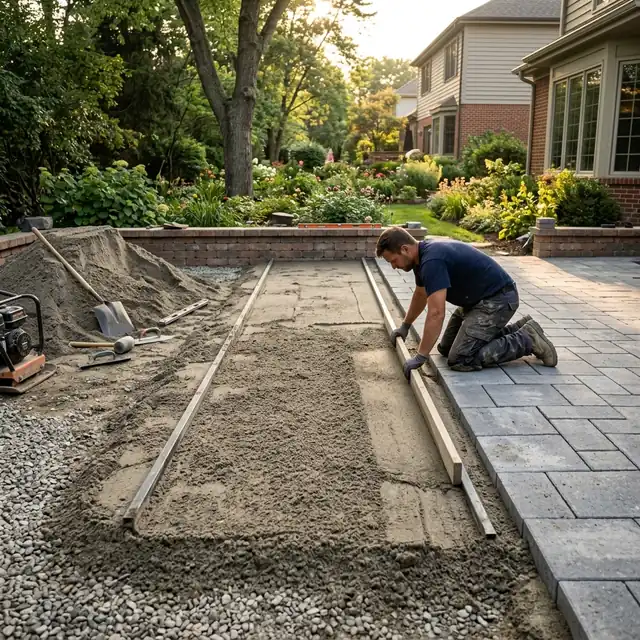
Screed the bedding sand with two 1-inch pipes as rails and a straight board between them. This gives a perfectly even 1-inch bed, and you should not walk on it or compact it before the pavers go down.

5

Keep bagged sand dry until you use it. Wet sand bulks up and measures larger than it really is, so a rain-soaked pile can leave your last section short.

Frequently Asked Questions

How much sand do I need under pavers?▼
A standard paver leveling bed should be exactly 1 inch of coarse concrete sand, spread over a compacted gravel base of 4 to 6 inches. Do not exceed 1 inch: a thicker sand layer lets pavers rock, shift, and eventually crack. A 100 sq ft patio at 1 inch needs about 0.31 cubic yards of sand.
How much does a cubic yard of sand weigh?▼
One cubic yard of dry sand weighs approximately 2,600 lbs (1.3 tons). Wet sand can weigh up to 3,200 lbs per cubic yard. Always check your vehicle's payload capacity before hauling, because even half a yard of wet sand can max out a small pickup.
How many bags of sand equal a cubic yard?▼
A standard 50 lb bag of sand contains about 0.5 cubic feet. You would need approximately 54 bags (50 lbs each) to equal one cubic yard of sand, since a cubic yard is 27 cubic feet. For anything over half a yard, bulk delivery is usually far cheaper than bags.
What type of sand is best for under pavers?▼
Coarse concrete sand (also called bedding sand or sharp sand) is the industry standard for the 1-inch paver bed, because its angular grains lock together instead of shifting. Polymeric sand, which hardens when wet, is a different product used only to fill the joints between pavers, where it prevents weeds and ant hills.
How much area does a 50 lb bag of sand cover?▼
A 50 lb bag of sand holds about 0.5 cubic feet, so it covers roughly 6 sq ft at 1 inch deep, or 3 sq ft at 2 inches deep. At the 1-inch depth used for paver beds, that means about 17 bags cover a 100 sq ft patio. Coverage drops fast as depth increases, so check your depth before counting bags.
How much sand do I need for a 10x10 paver patio?▼
A 10x10 foot patio needs a 1-inch sand bed: 100 sq ft at 1 inch is 8.3 cubic feet, or about 0.31 cubic yards of concrete sand. That equals roughly 17 bags of 50 lb sand. Remember the sand is only the top layer: it sits on 4 to 6 inches of compacted gravel base, which for the same patio is another 1.2 to 1.9 cubic yards.
How much does sand cost in 2026?▼
Bulk sand costs $15 to $35 per cubic yard in 2026, based on current supplier estimates, though delivery fees apply on small loads. Bagged sand runs $4 to $7 per 50 lb bag, so a full yard in bags (54 bags) costs $216 to $378, many times the bulk price. Polymeric sand for paver joints is the premium option at $25 to $40 per 50 lb bag.

Related Calculators

Related Guides