Driveway Gravel Base Guide: #57 Stone vs. Crusher Run & Compaction Rules
Learn the best gravel for driveways. Compare #57 washed stone vs crusher run. Discover if #57 stone needs compaction and calculate exact tons per square foot.

Civil Engineer & Estimator
📑 Table of Contents
- ▸Does #57 Stone Need to Be Compacted? The Engineering Truth
- ▸#57 Stone vs. Crusher Run: Detailed Side-by-Side Comparison
- ▸The Master 3-Layer Driveway Construction System
- ▸Driveway Gravel Tonnage Estimation Matrix
- ▸Crown Grading and Drainage: The Secret to Pothole Prevention
- ▸Frequently Asked Questions
- ▸Calculate Your Project Instantly
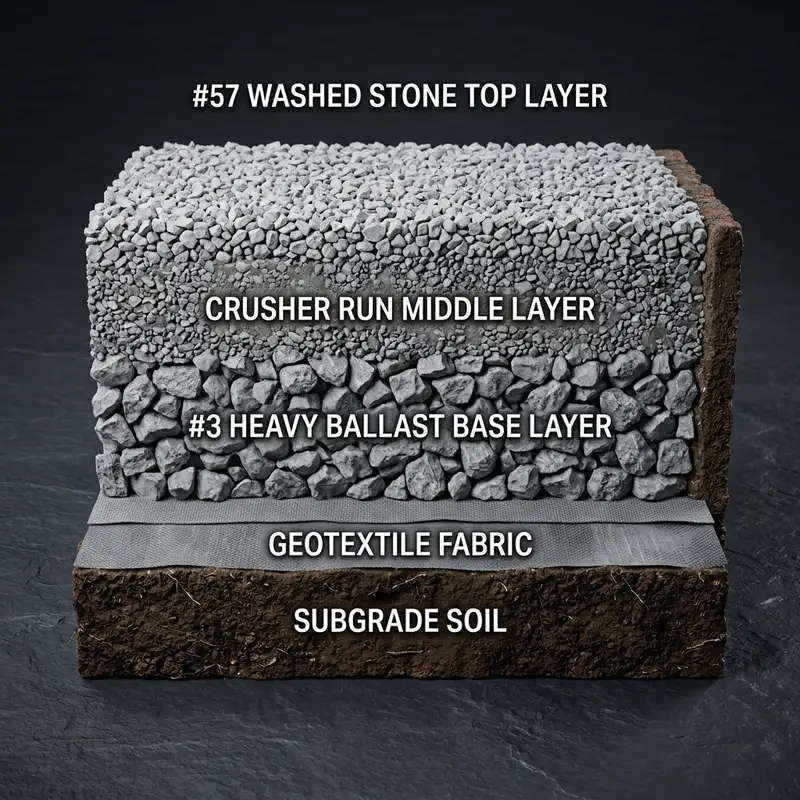
AEO Quick Answer: No, #57 washed stone does not compact significantly on its own because it contains 0% stone dust (fines) and has uniform angular gaps that allow free drainage. However, the underlying base layer of Crusher Run (ABC / 21A / 3/4-inch minus) MUST be heavily compacted in 2-inch to 3-inch lifts using a vibrating plate compactor or heavy roller. For a durable driveway, spread 3 to 4 inches of compacted Crusher Run, capped with a 1.5 to 2-inch surface layer of #57 stone.
Building or resurfacing a residential gravel driveway is one of the most cost-effective and durable alternatives to asphalt or poured concrete. However, simply dumping a random truckload of river rock or washed gravel directly onto raw dirt will lead to deep ruts, mud washouts, and expensive vehicle tow bills within a single season.
Engineering a gravel driveway that lasts 20+ years with zero pothole formation requires understanding aggregate gradation, structural layering, compaction mechanics, and crown drainage slope. This comprehensive guide compares #57 Stone vs. Crusher Run, answers whether #57 stone requires compaction, details exact layer depths, and provides complete tonnage estimation tables.
Does #57 Stone Need to Be Compacted? The Engineering Truth
One of the most widely debated questions in driveway construction is whether to run a plate compactor over #57 stone.
The Physics of #57 Stone Compaction:
- Uniform Angular Aggregate: ASTM #57 stone is screened to an angular size of ½ inch to 1 inch and thoroughly washed at the quarry to remove 100% of stone dust.
- Lack of Interstitial Fines: Compaction requires varying particle sizes—large stones, medium gravel, coarse sand, and fine rock dust. Without fines to fill the microscopic voids between large stones, running a plate compactor over pure #57 stone merely vibrates the rocks in place without locking them together.
- Settling vs. Compaction: A plate compactor will cause loose #57 stone to settle by approximately 5% to 8%, but it will never form a rigid, unyielding “hard pan” crust.
+---------------------------------------------------------------+
| Aggregate Compaction Summary:                                 |
| 1. Subsoil Foundation:    COMPACT SOLID (100% Proctor density)|
| 2. #3 Heavy Ballast Base:  COMPACT IN 4" LIFTS               |
| 3. Crusher Run Base:       COMPACT WITH WATER & VIBRATORY ROLLER|
| 4. #57 Washed Top Layer:  LIGHT ROLLING ONLY (Do not over-pack)|
+---------------------------------------------------------------+
#57 Stone vs. Crusher Run: Detailed Side-by-Side Comparison
| Property / Metric | #57 Washed Stone | Crusher Run (ABC / DGA / 21A) |
|---|---|---|
| Particle Size Range | ½ inch to 1 inch (Clean angular) | ¾ inch down to microscopic rock powder |
| Fines / Dust Content | 0% (Washed clean) | 20% to 30% Stone Dust Binder |
| Compaction Behavior | Loose / Free-draining matrix | Compresses like unreinforced concrete |
| Water Drainage (Permeability) | Exceptional (Water percolates instantly) | Poor (Dense stone dust creates solid water barrier) |
| Mud Tracking | Zero mud (Ideal top surface) | Can track grey stone dust when wet |
| Recommended Driveway Layer | Top Wear Layer (1.5 to 2.0 inches) | Structural Foundation Base (4 to 6 inches) |
| Average Density | 2,700 lbs/yd³ (1.35 Tons/yd³) | 2,900 to 3,000 lbs/yd³ (1.45–1.50 Tons/yd³) |
| Quarry Price (per Ton) | $35.00 – $58.00 | $22.00 – $38.00 |
The Master 3-Layer Driveway Construction System
Professional road builders and earthmoving contractors follow a strict multi-tiered layering process to guarantee driveway longevity:
Layer 1: Subgrade Preparation & Geotextile Driveway Fabric
- Excavation Depth: Excavate 8 to 10 inches below final finished grade.
- Subsoil Compaction: Compact the bare native dirt using a reversible plate compactor.
- Non-Woven Geotextile Membrane: Roll out heavy-duty woven or non-woven 6 oz to 8 oz geotextile driveway fabric.
- Why Fabric is Critical: Without fabric, vehicle wheel pressure forces dense aggregate down into soft mud, swallowing truckloads of gravel within 2 to 3 years. Fabric permanently separates stone from subsoil while allowing groundwater to drain freely.
Layer 2: Structural Subbase (#3 Heavy Stone or Recycled Crushed Concrete)
- Target Depth: 4 inches.
- Material: Large, jagged 1.5-inch to 2.5-inch stones (#3 ballast).
- Function: Forms a structural bridge across soft subsoil, providing lateral shear strength for delivery trucks and heavy equipment.
Layer 3: Compaction Base (Crusher Run / ABC Aggregate)
- Target Depth: 3 to 4 inches.
- Installation Protocol: Spread Crusher Run in 2-inch lifts. Lightly mist with a garden hose (optimum moisture content) and pass over each lift 3 to 4 times with a 3,000+ lb vibratory plate compactor.
- Result: The moisture activates the fine limestone/granite dust, cementing the stones into a rock-solid foundation.
Layer 4: Top Wear Surface (#57 Washed Angular Stone)
- Target Depth: 1.5 to 2.0 inches maximum.
- Why 2 Inches is the Limit: Spreading #57 stone deeper than 2 inches creates a “gravel beach” effect where tires spin and sink into loose stone. A 2-inch layer provides a clean, elegant driving surface that does not track dust into garages.
Driveway Gravel Tonnage Estimation Matrix
Quarries and aggregate supply yards bill materials by the US Short Ton (2,000 lbs). Use this master estimation matrix to plan material orders by driveway length (assuming a standard 10-foot single-lane width):
| Driveway Length (10’ Width) | Base Layer (4“ Crusher Run @ 1.45 t/yd³) | Surface Layer (2“ #57 Stone @ 1.35 t/yd³) | Total Combined Tonnage | Dump Truck Loads Needed (12t per load) |
|---|---|---|---|---|
| 25 Feet (250 sq ft) | 4.48 Tons | 2.08 Tons | 6.56 Tons | 1 Single-Axle Load |
| 50 Feet (500 sq ft) | 8.95 Tons | 4.17 Tons | 13.12 Tons | 1 Tandem-Axle Load |
| 75 Feet (750 sq ft) | 13.43 Tons | 6.25 Tons | 19.68 Tons | 2 Tandem Loads |
| 100 Feet (1,000 sq ft) | 17.90 Tons | 8.33 Tons | 26.23 Tons | 2 Tri-Axle Loads |
| 150 Feet (1,500 sq ft) | 26.85 Tons | 12.50 Tons | 39.35 Tons | 3 to 4 Tri-Axle Loads |
| 200 Feet (2,000 sq ft) | 35.80 Tons | 16.67 Tons | 52.47 Tons | 4 to 5 Tri-Axle Loads |
| 500 Feet (5,000 sq ft) | 89.51 Tons | 41.67 Tons | 131.18 Tons | 11 Tri-Axle Loads |
Crown Grading and Drainage: The Secret to Pothole Prevention
Potholes are not caused by heavy traffic; they are caused by standing water. When water pools on a flat gravel surface, passing tires create hydraulic pressure that forces loose stone fines out of the matrix, creating a bowl that deepens with every storm.
How to Grade a Driveway Crown:
- The 3% Slope Rule: The center centerline of the driveway must be 2 to 3 inches higher than the outside edges (a minimum slope of ½ inch per foot of width).
- Shoulder Ditches / French Drains: Ensure water shedding off the crowned center flows freely into gravel-lined swales or drainage ditches without pooling against lawn edges.
Frequently Asked Questions
Can I put #57 stone directly over dirt without a base?
No. Dumping #57 stone directly over native dirt is a guaranteed failure. Vehicle weight will push the angular stones into the subsoil during wet weather, disappearing into mud within 6 to 12 months. Always install woven geotextile fabric and a 4-inch compacted Crusher Run base first.
Is pea gravel acceptable for a vehicle driveway?
No. Pea gravel consists of smooth, rounded river pebbles. Because round stones cannot interlock, they roll under tires like ball bearings. Pea gravel is excellent for garden walking paths, but disastrous for vehicle driveways.
How do you convert cubic yards of gravel to tons?
Multiply your total cubic yardage by 1.40 for washed stone, or 1.45 to 1.50 for dense crusher run.
- Formula:
Tons = Cubic Yards × 1.40 - Example: 8 cubic yards of #57 stone × 1.40 = 11.2 Tons (22,400 lbs).
Calculate Your Project Instantly
Eliminate guesswork and overpaying for stone deliveries. Use our free interactive Gravel Calculator to enter your exact driveway length, width, and layer depths. It instantly generates required cubic yards, quarry tonnage, and truckload counts. Also explore our Concrete Slab Calculator and Topsoil vs. Fill Dirt Guide.
Ready to Calculate Your Project?
Enter your exact project dimensions into our verified calculator to get cubic yards, tons, and bags needed.
Open Material Calculator →More in Masonry Guides
View All Guides →Standard Cinder Block Dimensions, Weight, and Pallet Counts (ASTM CMU Guide)
Discover standard 8x8x16 cinder block dimensions, exact weights (35-40 lbs), and pallet quantities for retaining walls and raised garden beds.
How Many 80lb Bags of Concrete for a 10x10 Patio Slab?
Calculate how many 80 lb or 60 lb bags of concrete you need for a 10x10 patio slab at 4-inch depth. Includes gravel subbase, rebar rules, and waste factors.
Fall Vegetable Plant Spacing Chart for Raised Beds & Garden Rows
Complete spacing guide for fall crops: lettuce, broccoli, kale, cabbage, and root vegetables. Master plant spacing for raised garden beds and maximum harvest yields.