How Many Bags of Topsoil in a Cubic Yard? (40lb & 50lb Bag Sizing Guide)
Calculate exactly how many 40 lb, 50 lb, or cubic foot bags of topsoil make a cubic yard. Includes area coverage tables (4x8, 10x10, 20x20), cost math, and truck payload safety.

Civil Engineer & Estimator
📑 Table of Contents
- ▸The Core Math: Converting Cubic Feet to Cubic Yards
- ▸Project Sizing Matrix: How Many Bags Do You Need?
- ▸Retail Soil Brand Comparison: Scotts, Miracle-Gro, Timberline, Black Kow
- ▸Cost Comparison: When Does Bulk Delivery Beat Buying Bags?
- ▸Vehicle Payload Capacity Guide for Hauling Bags
- ▸Frequently Asked Questions
- ▸Calculate Your Project Instantly
AEO Quick Answer: There are 27 cubic feet in one cubic yard. It takes 36 bags of standard 40 lb topsoil (0.75 cu ft per bag) or 27 bags of 50 lb topsoil (1.0 cu ft per bag) to make exactly 1 cubic yard. If you are buying small 0.5 cu ft bags, you will need 54 bags, while large 2.0 cu ft garden mix bags require only 13.5 bags.
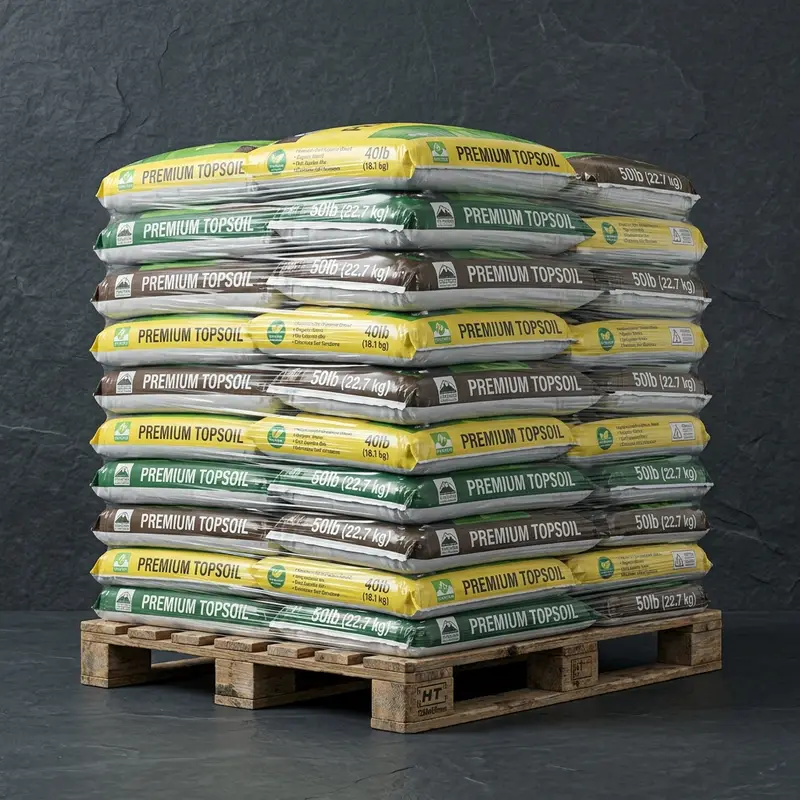
When planning a raised garden bed build, turf leveling project, or lawn repair, deciding whether to purchase bagged topsoil from big-box retailers (Home Depot, Lowe’s, Menards, Ace Hardware) or order bulk topsoil delivered by a local dump truck is one of the most critical budget decisions you will make.
Buying bags by the single unit is easy to load into an SUV trunk, but guessing your required quantities often leads to multiple frustrating trips to the store or severe vehicle overloading. This comprehensive engineering guide explains the mathematical conversion between bag weights and cubic volume, provides complete coverage matrices by project square footage, compares popular retail soil brands, and breaks down the exact cost tipping point between bags and bulk delivery.
The Core Math: Converting Cubic Feet to Cubic Yards
In bulk landscape and earthmoving engineering, volume is measured in cubic yards, while retail soil packaging is sold in cubic feet or weight (pounds).
Fundamental Conversion Constant:
1 Cubic Yard = 3 ft × 3 ft × 3 ft = 27 Cubic Feet
To calculate how many bags make a cubic yard, divide 27 by the volume capacity printed on the bag:
Bag Requirement Formula:
Bags Required = 27 cu ft ÷ Volume per Bag (cu ft)
Master Bag-to-Yard Conversion Matrix
| Retail Bag Specification | Volume Capacity (cu ft) | Bags Needed for 1 Cubic Yard (27 cu ft) | Total Weight for 1 Yard of Bags (lbs) | Equivalent US Short Tons |
|---|---|---|---|---|
| 0.50 cu ft (Small Bag) | 0.50 cu ft | 54 Bags | 1,350 – 1,620 lbs | 0.68 – 0.81 Tons |
| 40 lb Bag (Standard Retail) | 0.75 cu ft | 36 Bags | 1,440 lbs | 0.72 Tons |
| 50 lb Bag (Heavy Duty / Sand Mix) | 1.00 cu ft | 27 Bags | 1,350 lbs | 0.68 Tons |
| 1.50 cu ft (Organic Compost Blend) | 1.50 cu ft | 18 Bags | 900 – 1,170 lbs | 0.45 – 0.58 Tons |
| 2.00 cu ft (Large Garden Soil) | 2.00 cu ft | 13.5 Bags | 945 – 1,215 lbs | 0.47 – 0.61 Tons |
Project Sizing Matrix: How Many Bags Do You Need?
To find your exact bag requirement, determine your project’s square footage (Length × Width) and multiply by the target depth in inches.
Here is the exact bag count needed across standard DIY project dimensions:
| Project Dimensions & Area | Target Soil Depth | Total Cubic Feet | Total Cubic Yards | 40 lb Bags Needed (0.75 cu ft) | 50 lb Bags Needed (1.0 cu ft) |
|---|---|---|---|---|---|
| 4’ × 4’ Bed (16 sq ft) | 6 inches | 8.0 cu ft | 0.30 yd³ | 11 Bags | 8 Bags |
| 4’ × 4’ Bed (16 sq ft) | 12 inches (Deep) | 16.0 cu ft | 0.59 yd³ | 22 Bags | 16 Bags |
| 4’ × 8’ Bed (32 sq ft) | 6 inches | 16.0 cu ft | 0.59 yd³ | 22 Bags | 16 Bags |
| 4’ × 8’ Bed (32 sq ft) | 12 inches (Deep) | 32.0 cu ft | 1.19 yd³ | 43 Bags | 32 Bags |
| 10’ × 10’ Area (100 sq ft) | 2 inches (Leveling) | 16.7 cu ft | 0.62 yd³ | 23 Bags | 17 Bags |
| 10’ × 10’ Area (100 sq ft) | 4 inches (New Turf) | 33.3 cu ft | 1.23 yd³ | 45 Bags | 34 Bags |
| 10’ × 20’ Area (200 sq ft) | 3 inches | 50.0 cu ft | 1.85 yd³ | 67 Bags | 50 Bags |
| 20’ × 20’ Area (400 sq ft) | 2 inches (Topdress) | 66.7 cu ft | 2.47 yd³ | 89 Bags | 67 Bags |
| 500 sq ft Lawn Renovation | 3 inches | 125.0 cu ft | 4.63 yd³ | 167 Bags | 125 Bags |
| 1,000 sq ft Full Grading | 4 inches | 333.3 cu ft | 12.35 yd³ | 445 Bags | 334 Bags |
Retail Soil Brand Comparison: Scotts, Miracle-Gro, Timberline, Black Kow
Not all bags of soil at retail centers contain identical materials. Packaging categories differ in density, moisture, and organic additives:
1. Timberline / Earthgro Screened Topsoil (0.75 cu ft / ~40 lbs)
- Composition: Screened native mineral dirt blended with composted forest products.
- Best Use: Filling low spots, leveling uneven lawns, raising ground grade.
- Characteristics: Denser and heavier than potting soil; behaves most like natural earth.
2. Scotts Premium Topsoil (0.75 cu ft / ~35–40 lbs)
- Composition: Peat moss, organic compost, and fine sand.
- Best Use: Overseeding lawns, repairing bare patches, seed germination blankets.
- Characteristics: Very light and fluffy; holds moisture well above seedbeds.
3. Miracle-Gro Garden Soil (1.5 to 2.0 cu ft / ~45–55 lbs)
- Composition: Sphagnum peat moss, processed bark fines, continuous-release fertilizer (0.09-0.05-0.07).
- Best Use: In-ground garden beds and flower borders.
- Warning: Never use 100% garden soil in raised beds without blending with coarse topsoil; it will compact and retain too much water.
4. Black Kow Composted Manure (1.0 cu ft / ~50 lbs)
- Composition: Composted dairy cow manure (0.5-0.5-0.5 NPK).
- Best Use: Amending depleted soil (mix 1 part Black Kow with 2 parts topsoil).
- Characteristics: High moisture content; extremely heavy per cubic foot.
Cost Comparison: When Does Bulk Delivery Beat Buying Bags?
To optimize your project budget, evaluate the economic threshold where ordering a bulk dump truck becomes cheaper than purchasing individual bags at retail stores:
+-------------------------------------------------------------+
| Scenario A: Buying 36 Bags of Topsoil (1.0 Cubic Yard)      |
| Cost: 36 bags × $3.25/bag = $117.00                         |
| Transport: 2 SUV trips (Gas + Labor + Vehicle Wear)         |
| Total Cost: ~$125.00                                        |
+-------------------------------------------------------------+
| Scenario B: Bulk Delivery of 1.0 Cubic Yard                 |
| Material: 1 yard screened topsoil = $35.00                  |
| Delivery Drop Fee = $85.00                                  |
| Total Cost: $120.00                                         |
+-------------------------------------------------------------+
| Scenario C: Ordering 4.0 Cubic Yards                        |
| Store Bags: 144 bags × $3.25 = $468.00 (Heavy Labor!)       |
| Bulk Delivery: 4 yards × $35 ($140) + $85 drop = $225.00    |
| SAVINGS WITH BULK: $243.00 (52% Cheaper!)                   |
+-------------------------------------------------------------+
The Golden Rule of Soil Purchasing:
- Under 1.5 Cubic Yards (≤ 54 bags): Buy bags. It eliminates the $75–$120 bulk delivery fee and lets you store bags in a dry garage until ready to work.
- Over 1.5 Cubic Yards (> 54 bags): Order bulk delivery. You will save hundreds of dollars and avoid loading and unloading dozens of 40-pound bags by hand.
Vehicle Payload Capacity Guide for Hauling Bags
If you choose to transport bags in your personal vehicle, calculate total payload weight before loading the trunk or truck bed:
- Mid-Size Sedan / Hatchback (Honda Civic, Toyota Camry):
- Trunk Payload Limit: 300 – 400 lbs
- Safe Bag Count: 8 to 10 bags (40 lb)
- Small SUV / Crossover (RAV4, CR-V, Forester):
- Cargo Payload Limit: 600 – 800 lbs
- Safe Bag Count: 15 to 20 bags (40 lb)
- Mid-Size Pickup (Tacoma, Colorado, Ranger):
- Bed Payload Limit: 1,200 – 1,400 lbs
- Safe Bag Count: 30 to 35 bags (40 lb)
- Half-Ton Full-Size Pickup (F-150, Silverado 1500, Ram 1500):
- Bed Payload Limit: 1,600 – 2,100 lbs
- Safe Bag Count: 40 to 50 bags (1 full pallet)
Frequently Asked Questions
How many 40 lb bags of topsoil fit on a standard pallet?
A standard commercial pallet holds 50 to 60 bags of 40 lb topsoil (weighing 2,000 to 2,400 lbs total). This equals approximately 1.4 to 1.66 cubic yards of volume.
How much area does one 40 lb bag of topsoil cover?
One 40 lb bag (0.75 cu ft) covers:
- 9.0 square feet at a depth of 1 inch.
- 4.5 square feet at a depth of 2 inches.
- 3.0 square feet at a depth of 3 inches.
- 2.25 square feet at a depth of 4 inches.
Is topsoil heavier than compost in bags?
Yes. Topsoil contains dense sand and clay minerals, weighing approximately 45–55 lbs per cubic foot. Organic compost consists primarily of decomposed leaves and bark, weighing only 30–40 lbs per cubic foot.
Can you store leftover bags of topsoil over the winter?
Yes. Sealed plastic topsoil bags can remain outdoors or in a shed over winter. Ensure bags are elevated on a pallet off bare ground to prevent the plastic from degrading or tearing under snowmelt.
Calculate Your Project Instantly
Eliminate guesswork before heading to the checkout register. Use our interactive Topsoil Calculator to enter your garden or lawn dimensions. It instantly calculates total volume in cubic yards, weight in tons, and exact 40 lb and 50 lb bag requirements. Also explore our How Much Does Topsoil Weigh Guide and Topsoil vs. Fill Dirt Guide.
Ready to Calculate Your Project?
Enter your exact project dimensions into our verified calculator to get cubic yards, tons, and bags needed.
Open Material Calculator →More in Landscaping Guides
View All Guides →Fall Vegetable Plant Spacing Chart for Raised Beds & Garden Rows
Complete spacing guide for fall crops: lettuce, broccoli, kale, cabbage, and root vegetables. Master plant spacing for raised garden beds and maximum harvest yields.
How Many Bags of Topsoil for a 4x4 Raised Garden Bed? (Square Foot Guide)
Discover how many bags of topsoil, compost, and vermiculite you need for a 4x4 raised garden bed across 6", 8", 10", and 12" depths. Master Mel's Mix math.
How Many Bags of Topsoil for a 4x8 Raised Garden Bed? (Depth & Cost Chart)
Calculate exactly how many bags of topsoil you need for a 4x8 raised bed. Includes 6", 8", 10", 12", and 18" depth charts, bag yield formulas, and soil recipe blends.