Block Fill Calculator: Grout Volume per 100 Blocks
Work out grout for CMU walls: 0.33 cu ft per 8 inch block, 1.22 yards per 100 blocks, 55 bags per 100, and how much you save filling rebar cells only.

Civil Engineer & Estimator
📑 Table of Contents
AEO Quick Answer: A block fill calculator starts from one number: the cores of a standard 8x8x16 block hold 0.33 cubic feet of grout, so 81 fully filled blocks take 1 cubic yard. Filling 100 blocks solid needs 33 cubic feet, which is 1.22 cubic yards of grout, or about 55 bags of 80 lb mix. A 10 ft by 8 ft wall filled solid takes 1.1 cubic yards. For instant results, use our free cinder block calculator.
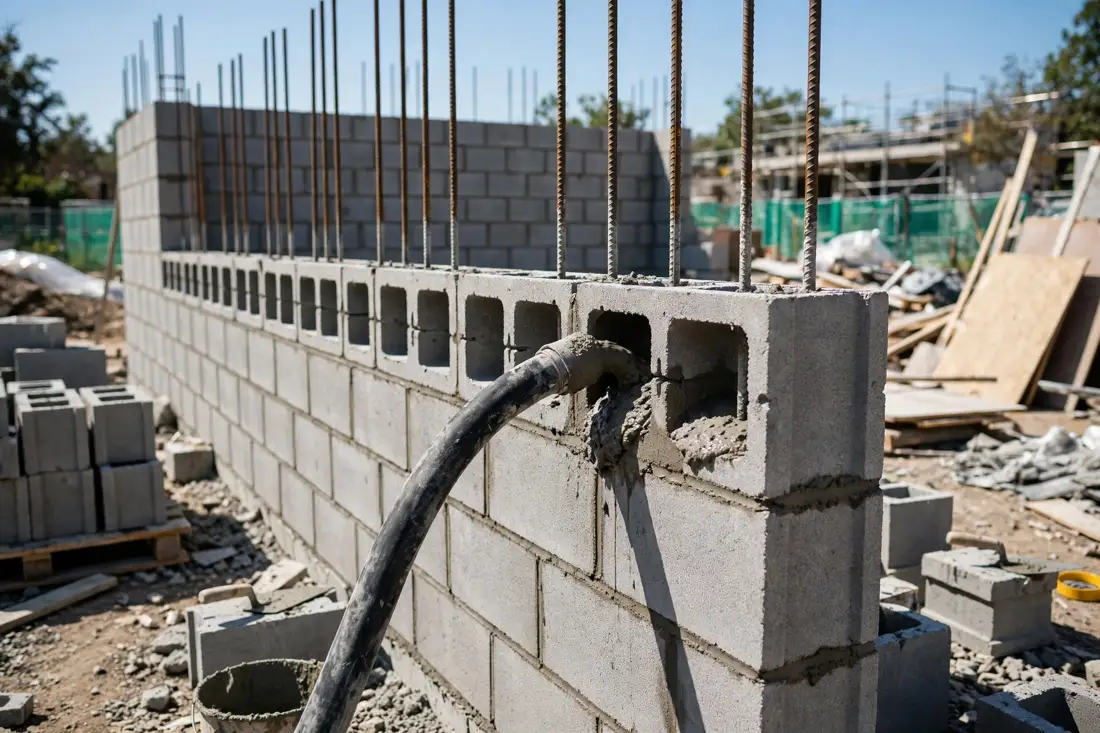
Hollow concrete block is strong in compression but weak where it matters most: against wind, soil pressure, and impact. Filling the block cores with grout, usually with steel rebar inside, turns a hollow wall into a solid reinforced one. The problem is ordering. Grout volume is invisible once the wall is up, suppliers sell it by the yard, and running short mid-lift leaves a cold joint inside the wall where it can never be fixed.
This guide gives you the core volume numbers by block size, the grout total per 100 blocks, a worked wall example, and the honest math on the big money question: filling every core versus filling only the reinforced cells.
The Core Numbers Behind Every Block Fill Calculation
One standard 8x8x16 block has two hollow cores. Together they hold:
Core volume per 8 inch block = 0.33 cubic feet of grout
From that single figure everything else follows:
- Blocks per cubic yard, filled solid: 27 / 0.33 = 81 blocks
- Per 100 blocks: 100 x 0.33 = 33 cubic feet = 1.22 cubic yards
- Bagged instead: 33 / 0.60 = 55 bags of 80 lb grout or concrete mix per 100 blocks
Grout Volume by Block Count (8 Inch Block, Filled Solid)
| Blocks Filled | Cubic Feet | Cubic Yards | 80 lb Bags |
|---|---|---|---|
| 50 | 16.5 | 0.61 | 28 |
| 100 | 33.0 | 1.22 | 55 |
| 200 | 66.0 | 2.44 | 110 |
| 500 | 165.0 | 6.11 | 275 |
Core Volume by Block Size
Wider blocks have bigger cores and drink far more grout. These core volumes match the sizing chart in our dimensions guide:
| Block Size (Nominal) | Core Volume per Block | Blocks per Cubic Yard |
|---|---|---|
| 4x8x16 | 0.12 cu ft | 225 |
| 6x8x16 | 0.20 cu ft | 135 |
| 8x8x16 | 0.33 cu ft | 81 |
| 10x8x16 | 0.44 cu ft | 61 |
| 12x8x16 | 0.55 cu ft | 49 |
A block fill calculator that ignores block width will miss the order badly on 12 inch work: the same 100 blocks need 2.04 cubic yards instead of 1.22.
Worked Example: 10 Ft by 8 Ft Wall
This is the sequence every block fill calculator follows: count the blocks, multiply by the core volume, then convert. Take a garden and retaining wall section 10 ft wide and 8 ft high, built from standard 8x8x16 block.
- Blocks per course: 10 ft / 1.33 ft per block = 7.5 blocks per course.
- Courses: 8 ft / 0.67 ft per course = 12 courses.
- Total blocks: 7.5 x 12 = 90 blocks.
- Grout, filled solid: 90 x 0.33 = 29.7 cubic feet = 1.1 cubic yards.
- Bagged: 29.7 / 0.60 = about 50 bags of 80 lb mix.
Order 1.25 yards from a truck to cover spillage and the pump line, or 55 bags if you are mixing by hand. Grout is placed in lifts, usually one story or about 4 ft of wall height at a time, so the liquid pressure does not blow out the bottom courses.
Filling Only the Reinforced Cells
Most walls do not need every core filled. Standard practice fills only:
- Cells with vertical rebar, typically spaced every 4 ft or less by design
- Corner and jamb cells beside openings
- The bond beam course at the top, a horizontal channel filled solid with rebar
On a typical wall that works out to roughly 1 in 6 cells filled, plus the bond beam. In practice, filling only the reinforced cells uses about 15 to 25 percent of the full-fill volume. Our example wall drops from 1.1 cubic yards filled solid to roughly 0.2 to 0.3 cubic yards with rebar cells and bond beam only. That is the difference between a truck order and a few dozen bags, so settle the fill plan with the engineer or code official before you price the job. A block fill calculator cannot know your rebar spacing, so run it twice: once at full fill for the ceiling price, and once at the reinforced share for the likely one. Solid filling is still specified for some retaining walls, flood walls, and high-load foundations, and there the full number stands.
Grout Is Not Mortar
The two materials get confused on site, and the mix-up is expensive. Mortar is the stiff, sticky mix troweled between blocks to bond courses. It is placed in 3/8 inch joints and would slump out of a core before it ever filled one. Grout is a fluid, high-slump mix designed to flow down through the cores and wrap the rebar. It uses smaller aggregate (pea gravel size) so it passes through the core openings without bridging. You can buy bagged grout mix, or use standard 80 lb concrete mix where the code allows it, since one bag yields the same 0.60 cubic feet either way. Never thin mortar with extra water and call it grout: the strength and flow both fail.
Frequently Asked Questions
What is the difference between grout and mortar?
Mortar is the stiff bonding mix spread in the 3/8 inch joints between blocks. Grout is a fluid, high-slump mix poured or pumped into the hollow cores so it flows around rebar and fills the cell solid. They are different mixes doing different jobs, and one cannot replace the other.
Do all the cores in a block wall need filling?
No. Most walls fill only the cells that carry vertical rebar, the corner and jamb cells, and the top bond beam course. That usually takes 15 to 25 percent of the full-fill grout volume. Solid filling every core is reserved for engineered walls such as retaining, flood, and high-load foundation walls.
How many bags of grout do I need per 100 blocks?
Filling 100 standard 8 inch blocks solid takes 33 cubic feet of grout. At 0.60 cu ft per 80 lb bag, that is 55 bags. Add a few spare bags for spillage, and remember that filling rebar cells only cuts the count to roughly 8 to 14 bags.
Should grout be pumped or placed by bucket?
Pump it on any wall of real size. A grout pump places a yard in minutes, fills tall lifts evenly, and keeps the mix consistent from bottom to top. Bucket placement works for small jobs, a few cells, or one short wall, but it is slow and risks voids where the bucket dumps miss a cell. Either way, rod or vibrate each lift lightly so the grout settles around the rebar without air pockets.
Calculate Your Block Fill Instantly
A block fill calculator is only the second half of the job; the block count comes first. Get your block count, wall weight, and mortar estimate from our free cinder block calculator, then use the 0.33 cu ft per block figure from this guide to total your grout. Need the block sizes and weights behind these numbers? Our cinder block dimensions and weight guide has the full ASTM sizing chart, pallet counts, and hauling limits.
Ready to Calculate Your Project?
Enter your exact project dimensions into our verified calculator to get cubic yards, tons, and bags needed.
Open Material Calculator →More in Masonry Guides
View All Guides →Bags vs Ready-Mix Concrete: When to Order a Truck
Bags vs ready mix concrete cost comparison for slabs and footings. Break-even charts, short-load fees, and the exact yardage where a truck wins.
Cement vs Concrete: What's the Actual Difference?
Cement vs concrete explained by an engineer: cement is the binder, concrete is the finished mix. Learn the 1-2-3 ratio, bag labels, and when the terms matter.
Standard Cinder Block Dimensions, Weight & Pallet Counts
Master standard CMU sizes, actual weights, and pallet quantities with our expert civil engineering guide to concrete block measurements and ASTM standards.