Concrete Mix Ratios: Cement, Sand, Aggregate per m³
Work out any concrete mix ratio with the dry volume method: cement bags, sand, and aggregate per cubic metre for M10, M15, M20, and M25 grades.

Civil Engineer & Estimator
📑 Table of Contents
- ▸What the Numbers in a Concrete Mix Ratio Mean
- ▸The 1.54 Dry Volume Factor, and Why Sources Argue About It
- ▸Cement, Sand, and Aggregate per Cubic Metre, by Grade
- ▸Worked Example: A 3 m × 3 m Slab in M15
- ▸The Per-Bag Shortcut for Site Mixing
- ▸Reading US Sources: The Imperial Bridge
- ▸Frequently Asked Questions
- ▸Calculate Your Concrete Project Instantly
AEO Quick Answer: A concrete mix ratio such as 1:2:4 (M15) means 1 part cement, 2 parts sand, and 4 parts aggregate by volume. For 1 cubic metre of finished M15 concrete you need 6.3 bags of cement (317 kg), 0.44 m³ of sand (about 704 kg), and 0.88 m³ of aggregate (about 1,364 kg), plus about 158 litres of water. The key step is the dry volume factor: multiply the wet volume by 1.54 before splitting it into parts. For imperial projects and bag counts by slab size, use our free concrete calculator instead.
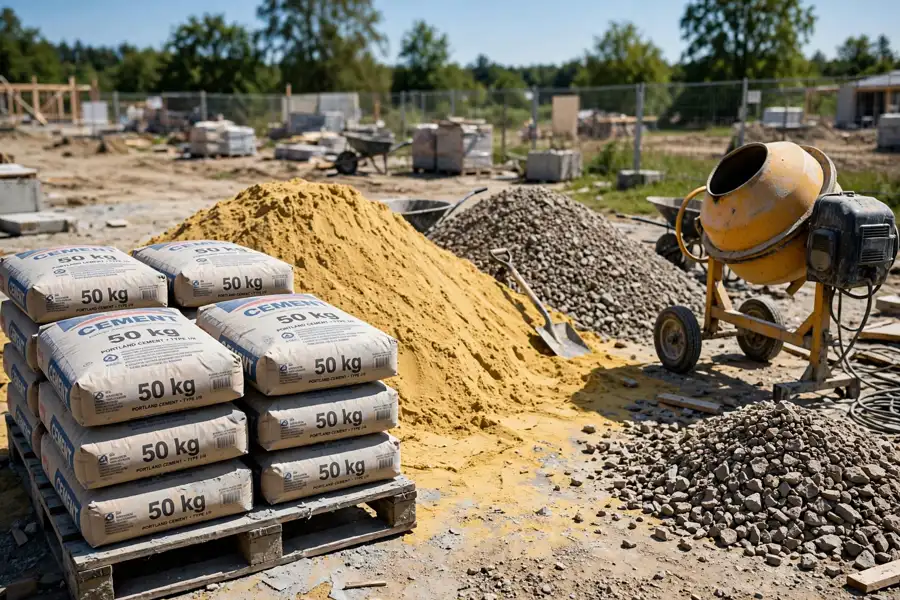
Most concrete ordered or mixed on small sites is not weighed on a plant scale. It is batched by volume, using a ratio, a measuring box, and bags of cement. That makes the cement sand aggregate calculation one of the most repeated jobs in construction, and one of the easiest to get wrong. The two mistakes that cost money are forgetting the dry volume factor, which leaves you short of material partway through a pour, and guessing the water, which quietly destroys strength.
This guide gives the full method once, with the numbers for the four grades used on almost every residential and small commercial job: M10, M15, M20, and M25. Every figure below comes from the same dry volume method taught in civil engineering and used across South Asia, so the table, the worked example, and the per-bag shortcut all agree with each other.
What the Numbers in a Concrete Mix Ratio Mean
A concrete mix ratio is written as cement : sand : aggregate, measured by volume. The ratio 1:2:4 means that for every 1 volume of cement you add 2 volumes of sand and 4 volumes of coarse aggregate. Water is handled separately through the water-cement ratio, covered below.
Each ratio belongs to a grade. The grade number is the target compressive strength in megapascals (MPa) after 28 days of curing, so M20 concrete is designed to reach about 20 MPa. Higher grades use proportionally more cement, which is why they cost more per cubic metre.
| Grade | Mix Ratio (Cement : Sand : Aggregate) | Typical Use |
|---|---|---|
| M10 | 1:3:6 | Lean concrete, base fill, levelling beds under floors and footings |
| M15 | 1:2:4 | General slabs, paths, driveways, and plain concrete work |
| M20 | 1:1.5:3 | Structural work: columns, beams, and reinforced (RCC) slabs |
| M25 | 1:1:2 | Heavy structural work and higher-strength reinforced elements |
The 1.54 Dry Volume Factor, and Why Sources Argue About It
Concrete is ordered and placed as wet volume: the size of the slab, beam, or column you are filling. But you buy and measure dry materials, and dry materials do not pack perfectly. Sand and aggregate contain air voids between their particles. When water is added and the mix is compacted into the formwork, those voids collapse and the total volume shrinks.
The standard correction is the dry volume factor:
Dry Volume Formula:
• Dry volume =Wet volume × 1.54
• Cement volume =Dry volume × (cement parts ÷ total parts)
• Cement weight =Cement volume × 1,440 kg/m³
• Bags of cement =Cement weight ÷ 50 kg per bag
So 1 cubic metre of wet concrete needs 1.54 cubic metres of dry materials measured loose.
Forum threads argue about this number because published sources use anything from 1.50 to 1.57. The honest position is that 1.54 is the standard teaching value, and the true factor for a given sand and aggregate sits within about 5 percent of it either way, depending on how wet the sand is and how angular the aggregate is. For ordering material on a real job, that small uncertainty is exactly why you round cement bags up and keep a small waste margin, rather than pretending any factor gives an exact answer to the last kilogram.
Cement, Sand, and Aggregate per Cubic Metre, by Grade
The table below is the full cement sand aggregate calculation for 1 cubic metre of wet, placed concrete, using the 1.54 factor, cement density of 1,440 kg/m³, sand at about 1,600 kg/m³, and aggregate at about 1,550 kg/m³. Cement is given in 50 kg bags, the standard bag size for metric batching.
| Grade | Ratio | Cement (50 kg bags) | Cement (kg) | Sand (m³ / kg) | Aggregate (m³ / kg) |
|---|---|---|---|---|---|
| M10 | 1:3:6 | 4.4 bags | 222 kg | 0.462 m³ / about 739 kg | 0.924 m³ / about 1,432 kg |
| M15 | 1:2:4 | 6.3 bags | 317 kg | 0.44 m³ / about 704 kg | 0.88 m³ / about 1,364 kg |
| M20 | 1:1.5:3 | 8.1 bags | 403 kg | 0.42 m³ / about 672 kg | 0.84 m³ / about 1,302 kg |
| M25 | 1:1:2 | 11.1 bags | 554 kg | 0.385 m³ / about 616 kg | 0.77 m³ / about 1,194 kg |
Water is set by the water-cement (w/c) ratio. At a w/c of 0.50, a common starting point for workable structural concrete, M15 needs about 158 litres per cubic metre and M20 needs about 200 litres. More water makes the mix easier to place but weaker; less water makes it stronger but harder to compact. Never add water beyond the ratio just to make mixing easier.
Worked Calculation: M15, Step by Step
- Total parts = 1 + 2 + 4 = 7 parts.
- Dry volume = 1 m³ × 1.54 = 1.54 m³.
- Cement = 1.54 × (1 ÷ 7) = 0.22 m³. Weight = 0.22 × 1,440 = 317 kg, which is 317 ÷ 50 = 6.3 bags.
- Sand = 1.54 × (2 ÷ 7) = 0.44 m³, about 704 kg.
- Aggregate = 1.54 × (4 ÷ 7) = 0.88 m³, about 1,364 kg.
- Water at w/c 0.50 = 317 × 0.50 = about 158 litres.
The same six steps work for any grade and any volume: change the parts, change the starting volume, and keep the 1.54 factor and the densities the same.
Worked Example: A 3 m × 3 m Slab in M15
Say you are casting a small yard slab, 3 metres by 3 metres and 100 mm thick.
- Wet volume = 3 × 3 × 0.1 = 0.9 m³.
- Cement = 0.9 × 6.3 = 5.7 bags. Round up and buy 6 bags.
- Sand = 0.9 × 0.44 = 0.40 m³ (about 634 kg).
- Aggregate = 0.9 × 0.88 = 0.79 m³ (about 1,228 kg).
Scaling from the per-cubic-metre table like this is the fastest reliable way to price a small pour. Add one extra bag of cement if the slab is exposed to weather or carries vehicle loads, since site mixing is never as consistent as plant mixing.
The Per-Bag Shortcut for Site Mixing
On site, concrete is usually mixed one bag at a time, so the most useful form of the concrete mix ratio is what goes with a single 50 kg bag. One bag of cement is 0.035 m³ (50 ÷ 1,440). For the 1:2:4 M15 mix, each bag takes:
| Per 50 kg Bag of Cement (1:2:4) | Quantity |
|---|---|
| Sand | 0.07 m³ (about 112 kg) |
| Aggregate | 0.14 m³ (about 217 kg) |
| Water at w/c 0.50 | About 25 litres |
Batching by the bag keeps every mix in the pour identical, which matters more for strength than chasing decimal places. Use a measuring box or a counted number of level buckets for the sand and aggregate rather than guessing with a shovel, since shovel counts drift as workers tire.
Reading US Sources: The Imperial Bridge
Many online guides and videos use imperial units, and the method converts cleanly. One cubic yard equals 0.765 cubic metres, so a per-cubic-metre figure from the table above converts to a per-cubic-yard figure by multiplying by 0.765. Bag sizes differ too: the standard US bag is 80 lb and yields about 0.60 cubic feet of concrete, while the metric method here is built on the 50 kg bag at 0.035 m³. If a US source gives you a bag count per cubic yard, convert the volume first and rebuild the count from the ratio, rather than mixing the two bag sizes in one calculation.
Frequently Asked Questions
Why do you multiply by 1.54?
Dry sand and aggregate are full of air gaps between their particles. When water is added and the mix is placed and compacted, those gaps collapse and the material occupies less space than it did loose. Multiplying the wet volume by 1.54 gives the volume of dry materials you actually need to buy and measure so that, after the voids collapse, you are left with the full wet volume you designed for. Skip the factor and a 1 m³ pour comes up roughly a third short.
How many bags of cement in 1 cubic metre of M20?
8.1 bags of 50 kg cement, which is 403 kg. The working: dry volume 1.54 m³, total parts 5.5 (1 + 1.5 + 3), so cement is 1.54 × (1 ÷ 5.5) = 0.28 m³, and 0.28 × 1,440 kg/m³ = 403 kg. In practice you would buy 9 bags to cover spillage and the partial bag.
What is the 1:2:4 mix used for?
The 1:2:4 ratio is M15, the general-purpose grade. It suits floor slabs, paths, driveways, garden structures, and plain (unreinforced) concrete work where loads are modest. For reinforced structural elements such as columns, beams, and RCC roof slabs, step up to M20 (1:1.5:3), which carries more cement and reaches a higher design strength.
How much water per bag of cement?
About 25 litres per 50 kg bag at a water-cement ratio of 0.50, which is the standard starting point for workable, durable concrete. The rule is simple: water in litres roughly equals half the cement weight in kilograms. Adding extra water to make the mix flow more easily is the most common site mistake; every extra litre lowers the final strength.
Calculate Your Concrete Project Instantly
Skip the hand arithmetic and get exact material lists for your slab, footing, or column. Use our free interactive Concrete Calculator to enter your dimensions and generate total concrete volume, bag counts by bag size, and estimated weight. If you are still choosing between bagged and ready-mix material, or between cement products, read our companion guide on cement vs. concrete first, since the two terms are often confused and the difference decides what you actually order.
Ready to Calculate Your Project?
Enter your exact project dimensions into our verified calculator to get cubic yards, tons, and bags needed.
Open Material Calculator →More in Masonry Guides
View All Guides →Bags vs Ready-Mix Concrete: When to Order a Truck
Bags vs ready mix concrete cost comparison for slabs and footings. Break-even charts, short-load fees, and the exact yardage where a truck wins.
Block Fill Calculator: Grout Volume per 100 Blocks
Work out grout for CMU walls: 0.33 cu ft per 8 inch block, 1.22 yards per 100 blocks, 55 bags per 100, and how much you save filling rebar cells only.
Cement vs Concrete: What's the Actual Difference?
Cement vs concrete explained by an engineer: cement is the binder, concrete is the finished mix. Learn the 1-2-3 ratio, bag labels, and when the terms matter.