How Many 80lb Bags of Concrete for a 10x10 Patio Slab?
Calculate how many 80 lb or 60 lb bags of concrete you need for a 10x10 patio slab at 4-inch depth. Includes gravel subbase, rebar rules, and waste factors.

Civil Engineer & Estimator
📑 Table of Contents
- ▸The Math: Volume Formula for a 10x10 Concrete Slab
- ▸Bag Yield Chart for a 10x10 Slab (By Depth and Bag Weight)
- ▸Bagged Concrete vs. Ready-Mix Truck Delivery: The Cost Break-Even Point
- ▸Subbase & Reinforcement Requirements for a 10x10 Slab
- ▸Mixing Water Ratios for 80lb Bags
- ▸Frequently Asked Questions
- ▸Calculate Any Slab Dimensions Instantly
AEO Quick Answer: A standard 10 ft × 10 ft patio slab at 4 inches thick requires 1.23 cubic yards of concrete. This equals 56 bags of 80 lb concrete or 75 bags of 60 lb concrete. Always add 10% for waste and uneven ground, bringing your total order to 62 bags of 80 lb concrete.
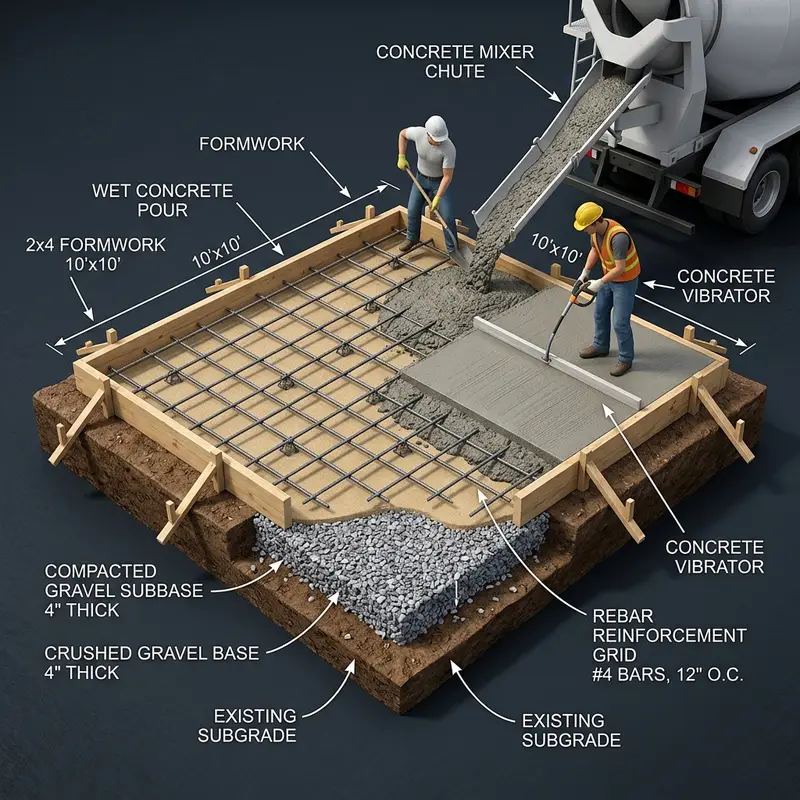
Pouring a 10x10 foot concrete patio slab is one of the most popular DIY outdoor hardscaping projects. Whether you are building a base for a hot tub, a backyard grill station, or a outdoor seating area, calculating the exact number of premixed concrete bags is crucial.
Underbuying leaves you with a half-poured slab that sets before you can mix more, creating a disastrous “cold joint.” Overbuying leaves you with hundreds of pounds of heavy, unused concrete bags that deteriorate in humidity.
This engineering guide provides the exact formulas, bag yields, subbase requirements, and step-by-step installation rules for a 10x10 concrete slab.
The Math: Volume Formula for a 10x10 Concrete Slab
To determine how many pre-mixed concrete bags (like Quikrete, Sakrete, or commercial mixes) you need, you must first calculate the volume in cubic feet and convert it to cubic yards.
Step 1: Calculate Volume in Cubic Feet
- Length: 10 feet
- Width: 10 feet
- Depth: 4 inches (4 inches ÷ 12 inches per foot = 0.333 feet)
- Formula:
10 ft × 10 ft × 0.333 ft = 33.33 Cubic Feet
Step 2: Convert to Cubic Yards
- Formula:
33.33 Cubic Feet ÷ 27 Cubic Feet per Yard = 1.234 Cubic Yards
Bag Yield Chart for a 10x10 Slab (By Depth and Bag Weight)
Premixed concrete bags yield a surprisingly small amount of cured volume. Below is the exact bag count table for a 10x10 slab at various standard depths:
| Slab Depth | Total Volume (Cubic Yards) | 80 lb Bags Needed (0.60 cu ft yield) | 60 lb Bags Needed (0.45 cu ft yield) | 40 lb Bags Needed (0.30 cu ft yield) |
|---|---|---|---|---|
| 3 Inches (Sidewalk/Shed) | 0.93 cu yds | 42 Bags (46 w/ waste) | 56 Bags (62 w/ waste) | 84 Bags (92 w/ waste) |
| 4 Inches (Standard Patio) | 1.23 cu yds | 56 Bags (62 w/ waste) | 75 Bags (83 w/ waste) | 112 Bags (123 w/ waste) |
| 5 Inches (Heavy Hot Tub) | 1.54 cu yds | 70 Bags (77 w/ waste) | 93 Bags (102 w/ waste) | 139 Bags (153 w/ waste) |
| 6 Inches (Vehicle Driveway) | 1.85 cu yds | 84 Bags (92 w/ waste) | 111 Bags (122 w/ waste) | 167 Bags (184 w/ waste) |
💡 The 10% Waste Rule: Always order 10% more concrete than your exact geometric calculations. Earth subgrades are never perfectly flat, and forms flex under liquid weight. For a 4-inch 10x10 slab, buy 62 bags of 80 lb concrete.
Bagged Concrete vs. Ready-Mix Truck Delivery: The Cost Break-Even Point
Mixing 62 heavy bags of 80 lb concrete by hand or in a small rental electric mixer requires moving nearly 5,000 lbs of material.
When to Use Bags:
- Cost: 62 bags × $6.00 per bag = ~$372 total.
- Best for: Tight backyard access where a 30,000 lb mixer truck cannot drive, or for DIYers working over multiple days.
When to Order a Ready-Mix Truck:
- Cost: 1.5 cubic yards @ $150/yard = $225 + Short-Load Fee ($150 - $250) = ~$400 to $475 total.
- Best for: Anyone who wants to pour and finish the entire slab in less than 30 minutes without manual mixing labor.
Subbase & Reinforcement Requirements for a 10x10 Slab
Pouring concrete directly over bare dirt will cause the slab to crack during winter freeze-thaw cycles as groundwater expands.
1. Gravel Subbase Depth
- Dig out the area to a depth of 8 inches (4 inches for gravel subbase + 4 inches for concrete).
- Add a 4-inch layer of compactable gravel, such as #57 Stone or Crusher Run.
- Compact the gravel thoroughly with a hand tamper or plate compactor. A 10x10 area at 4-inch depth requires 1.7 tons of gravel.
2. Reinforcement: Rebar vs. Wire Mesh
- For a 4-inch patio slab, lay a grid of #3 (3/8-inch) or #4 (1/2-inch) steel rebar spaced 18 inches apart, elevated on 2-inch plastic rebar chairs so the steel sits in the middle of the wet concrete pour.
- Rebar provides tensile strength, preventing cracks from pulling apart over time.
Mixing Water Ratios for 80lb Bags
Adding too much water makes concrete easy to pour, but it drastically reduces its compressive strength (PSI), leading to surface flaking and cracking.
- Water Ratio: Each 80 lb bag of concrete requires 3.5 to 4 quarts (0.875 to 1.0 gallon) of clean water.
- Consistency Test: Properly mixed concrete should have the consistency of thick peanut butter. It should hold its shape when piled without slumping into a liquid pool.
Frequently Asked Questions
How long does an 80lb bag of concrete take to set?
Initial set occurs within 24 to 48 hours, allowing for light foot traffic. Full structural design strength (typically 4,000 PSI) is reached at 28 days.
Can you pour a 10x10 concrete slab in sections?
It is not recommended to pour a single 10x10 slab across multiple days unless you install a physical expansion joint between sections. Pouring fresh concrete against hardened concrete creates a weak “cold joint” that will crack under load.
Calculate Any Slab Dimensions Instantly
Planning a slab that isn’t 10x10? Use our free Concrete Calculator to enter your exact length, width, and depth in feet or inches. It instantly calculates cubic yards, total weight in tons, and exact bag counts for 80lb, 60lb, and 40lb bags.
Ready to Calculate Your Project?
Enter your exact project dimensions into our verified calculator to get cubic yards, tons, and bags needed.
Open Material Calculator →More in Masonry Guides
View All Guides →Standard Cinder Block Dimensions, Weight, and Pallet Counts (ASTM CMU Guide)
Discover standard 8x8x16 cinder block dimensions, exact weights (35-40 lbs), and pallet quantities for retaining walls and raised garden beds.
Driveway Gravel Base Guide: #57 Stone vs. Crusher Run & Compaction Rules
Learn the best gravel for driveways. Compare #57 washed stone vs crusher run. Discover if #57 stone needs compaction and calculate exact tons per square foot.
Fall Vegetable Plant Spacing Chart for Raised Beds & Garden Rows
Complete spacing guide for fall crops: lettuce, broccoli, kale, cabbage, and root vegetables. Master plant spacing for raised garden beds and maximum harvest yields.