Concrete Steps Calculator: Volume, Bags & Formula
Calculate concrete for steps with the stacked-box formula, a worked 3-step example, bags for 1 to 5 steps, and the code rules for riser and tread size.

Civil Engineer & Estimator
📑 Table of Contents
AEO Quick Answer: A concrete steps calculator treats a staircase as stacked boxes. For 3 steps with a 7 inch rise, 11 inch tread, and 4 ft width, the volume is 12.8 cubic feet, which is 0.48 cubic yards, or about 22 bags of 80 lb mix. Order 24 bags with the waste allowance. Code limits each riser to 7 to 7.75 inches and requires treads of at least 10 to 11 inches. For instant results, use our free concrete calculator.
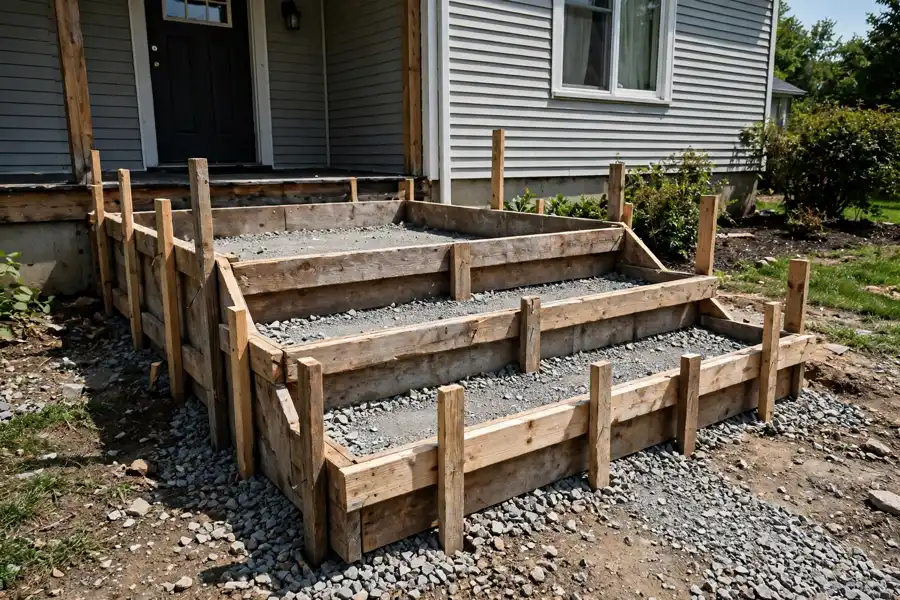
Concrete steps look simple, but the volume hides a trap. Each step is a full box of concrete, and the boxes stack: the bottom step is one unit tall, the next is two, the next is three. Builders who price a 3-step stoop as three flat slabs order about a third too little concrete and run short mid-pour, with forms full and the top step still empty.
This guide gives you the step formula, a worked example you can copy, a bag table for 1 to 5 steps, and the building code rules that fix your riser and tread sizes before any math starts.
The Step Formula
Look at a staircase from the side. Its profile is a triangle of boxes. If each step has a rise of R and a tread of T, and the flight has n steps, the side profile area is:
Profile area (sq ft) = Rise (ft) x Tread (ft) x n(n+1) / 2
The term n(n+1)/2 counts the stacked boxes: 1 step is 1 box, 2 steps are 1 + 2 = 3 boxes, 3 steps are 1 + 2 + 3 = 6 boxes, and so on. Then:
Volume (cubic feet) = Profile area x Width (ft) Bags of 80 lb mix = Cubic feet / 0.60
That stacked-box count is the whole trick inside every concrete steps calculator. Once you see the profile as a triangle of boxes, the rest is one multiplication.
Worked Example: 3 Steps, 4 Ft Wide
A concrete steps calculator does this in one click. Here is the same math by hand, using standard residential steps: 7 inch rise, 11 inch tread, 4 ft wide.
- Convert: rise 7 inches = 0.583 ft. Tread 11 inches = 0.917 ft.
- Box count: 3 steps give 3 x 4 / 2 = 6 boxes.
- Profile area: 0.583 x 0.917 x 6 = 3.21 sq ft.
- Volume: 3.21 x 4 ft wide = 12.8 cubic feet.
- Yards: 12.8 / 27 = 0.48 cubic yards.
- Bags: 12.8 / 0.60 = about 22 bags of 80 lb mix.
- Add 10 percent waste: 24 bags to order.
Bags for 1 to 5 Steps
All rows use a 4 ft width, 7 inch rise, and 11 inch tread. Bag counts include about 10 percent waste where the exact count rounds up.
| Steps | Profile Boxes | Volume | 80 lb Bags to Buy |
|---|---|---|---|
| 1 | 1 | 2.14 cu ft | 4 |
| 2 | 3 | 6.4 cu ft | 12 |
| 3 | 6 | 12.8 cu ft | 24 |
| 4 | 10 | 21.4 cu ft | 39 |
| 5 | 15 | 32.1 cu ft | 59 |
Read the pattern before you scale a bigger flight. Five steps hold 15 boxes, not 5, so a tall stoop eats concrete fast. At 5 steps you are at 1.19 cubic yards and 59 bags, which is past the point where most builders switch to a ready-mix truck. A concrete steps calculator keeps this honest, because the growth is squared, not straight.
For a different width, scale the bag count by width: a 3 ft wide flight needs three quarters of the table value, and a 6 ft wide flight needs one and a half times it. Any concrete steps calculator does this same scaling automatically when you change the width field.
The Step Rules: Riser and Tread Sizes
Codes fix step geometry because uneven steps trip people. The numbers below follow the standard residential rules. Confirm with your local code, but never design outside these ranges:
- Riser height: 7 to 7.75 inches maximum. Most builders target 7 inches exactly. Shorter risers are allowed, but porch steps under 4 inches feel like a trip ledge rather than a step.
- Tread depth: at least 10 to 11 inches. The tread is the flat part your foot lands on, measured front to back. Eleven inches fits a full shoe with margin.
- Every riser in one flight must be equal. Codes typically allow no more than 3/8 inch difference between the tallest and shortest riser in a flight. The human leg learns the rhythm of the first step and expects the rest to match.
- Total rise first, then divide. Measure the full height from landing to landing, then divide by your target riser height and round to a whole number of steps. Fourteen inches of total rise is 2 steps of 7 inches. Twenty-one inches is 3 steps of 7 inches. Never force the leftover into one tall bottom step.
Get the geometry right before the concrete math, because the formula needs your final rise and tread, not your first guess.
The Landing and Base Are Extra
The formula above counts only the steps themselves, and a standard concrete steps calculator leaves the rest out too. Two common additions sit outside it:
- A landing slab at the top or bottom. A 4 ft by 3 ft landing at 4 inches thick is 4 cubic feet, about 7 more bags. Price it as its own small slab.
- A footing strip under the bottom step. Steps poured on soft or filled soil need a thickened base, often 8 inches deep across the width, so the flight does not settle and pull away from the house. Count that trench volume separately.
Many stoops also sit on a gravel base of 2 to 4 inches for drainage. Gravel is cheap insurance against frost lift under a shallow stoop, and it does not change the concrete count.
Reinforcement: Rebar and Mesh
Steps are small, but they still crack if the ground moves. Standard practice is a grid of number 4 rebar (1/2 inch) or welded wire mesh through the flight, with the steel tied into the landing and the foundation wall where the steps meet the house. Keep steel at least 2 inches clear of every surface so it cannot rust through the face. On tall flights, two horizontal bars running the width of each step add real strength for very little cost. Reinforcement does not reduce the concrete volume; the steel displaces almost nothing, so do not subtract it from your bag count.
Frequently Asked Questions
What is the formula for concrete steps?
Multiply rise by tread by the box count n(n+1)/2 to get the side profile area, then multiply by the step width for cubic feet. For 3 steps at a 7 inch rise and 11 inch tread, the area is 3.21 sq ft, and a 4 ft wide flight holds 12.8 cubic feet.
How many bags of concrete do I need for 3 steps?
A 3-step flight, 4 ft wide with a 7 inch rise and 11 inch tread, holds 12.8 cubic feet. That is about 22 bags of 80 lb mix, or 24 bags ordered with the 10 percent waste allowance.
Is the landing included in the step calculation?
No. The step formula counts the stacked step boxes only. A landing slab at the top or bottom is priced separately as a flat slab: length by width by thickness. A typical 4 ft by 3 ft landing at 4 inches thick adds about 4 cubic feet, roughly 7 bags.
Do concrete steps need rebar?
Yes, on all but the smallest stoops. A grid of number 4 rebar or welded wire mesh ties the flight together and limits cracking when the soil settles. Keep the steel 2 inches clear of the surface, and tie it into the landing or foundation where the steps meet the building.
Calculate Your Steps Instantly
Enter your step count, rise, tread, and width in our free concrete calculator and get exact cubic yards and bag counts without the hand math. Pouring the flat patio or walkway that meets the steps? Our how many bags of concrete for a slab guide works out bag counts by slab size and thickness.
Ready to Calculate Your Project?
Enter your exact project dimensions into our verified calculator to get cubic yards, tons, and bags needed.
Open Material Calculator →More in Masonry Guides
View All Guides →Bags vs Ready-Mix Concrete: When to Order a Truck
Bags vs ready mix concrete cost comparison for slabs and footings. Break-even charts, short-load fees, and the exact yardage where a truck wins.
Block Fill Calculator: Grout Volume per 100 Blocks
Work out grout for CMU walls: 0.33 cu ft per 8 inch block, 1.22 yards per 100 blocks, 55 bags per 100, and how much you save filling rebar cells only.
Cement vs Concrete: What's the Actual Difference?
Cement vs concrete explained by an engineer: cement is the binder, concrete is the finished mix. Learn the 1-2-3 ratio, bag labels, and when the terms matter.